
Most people believe their car insurance rate depends on three things: their driving record, their age, and maybe their credit score if they live in a state that still allows insurers to use it. What surprises many drivers is that where they park their car overnight can meaningfully change what they pay.
It is a detail that gets overlooked during the application process. The parking question appears on every policy form. Most people answer it without much thought. That single answer can affect your rate for years.
Will a garage actually lower your car insurance rates? The short answer is yes — but it depends on the type of coverage you carry, the type of garage you have, and which state you live in. This article walks through each of those factors so you can make an informed decision.
Why Insurers Pay Attention to Where You Park
Insurance pricing is built on one core principle: the more likely a claim is, the more a policy costs. Every factor your insurer evaluates connects back to that logic. Garaging your car changes the probability of several types of claims simultaneously.
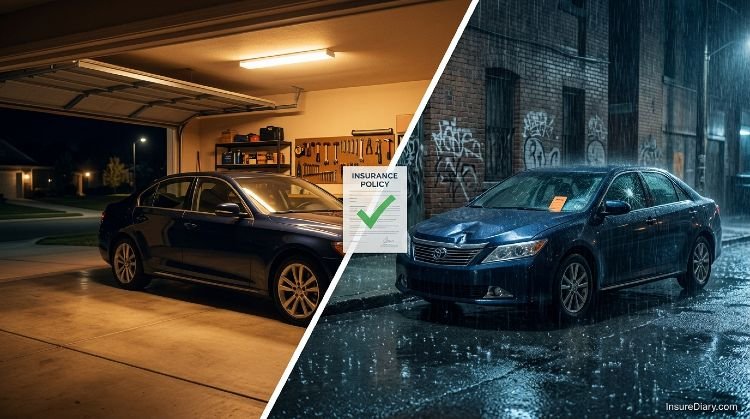
A vehicle parked on a public street overnight faces a longer list of risks than one sitting inside a private enclosed structure.
Auto theft is the most obvious. According to the National Insurance Crime Bureau’s vehicle theft reporting, vehicle theft remains a serious concern in urban and suburban areas across the US with certain ZIP codes showing rates well above the national average. A car locked inside a private garage is a significantly harder target.
Vandalism runs a close second. Keying, broken windows, and tire damage happen far more often to vehicles sitting on public streets than to those in enclosed spaces.
Weather damage rounds out the top three. Hail in Texas. Ice storms in the Midwest. Wind-driven debris during summer storms. Each of those events generates comprehensive insurance claims that cost insurers real money. A garage cuts the exposure on all three fronts.
That reduced exposure translates into a lower risk profile for your vehicle. Lower risk generally points toward a lower premium.
What the Discount Actually Covers
The pricing benefit from garaging your car shows up primarily in one place.
Comprehensive coverage is the portion of your auto policy that pays for theft, weather damage, fire, vandalism, and other non-collision events. This is where garaging your vehicle has the most direct effect.
Collision coverage is less influenced by overnight parking location because collisions happen while you are driving.
Liability coverage is also not directly connected to where you park. Liability covers damage you cause to others on the road. Where your car sits at midnight does not change that risk.
So when someone asks whether a garage lowers car insurance across the board, the more precise answer is: it primarily affects your comprehensive coverage.
That distinction matters when you are evaluating whether the savings are worth pursuing. For many drivers, comprehensive coverage costs somewhere between $150 and $350 per year depending on vehicle value, location, and deductible chosen. A reduction of 5% to 15% on that portion means annual savings in the range of $10 to $50 in many cases.
It is not a dramatic number on its own. But it stacks with other discount factors, and that is where it becomes worth your attention. Our article on insurance discounts most people qualify for but never claim covers how these kinds of stacking adjustments work across your full policy.

Which Garage Types Actually Qualify
Not every garage situation is treated equally. This is where drivers sometimes make incorrect assumptions.
Fully enclosed private garage attached to your home. This is the strongest version. Insurers view this as the most protective option because it limits public access and protects against weather from all sides.
Fully enclosed private garage detached from your home. This typically qualifies too. The key factor is private access — you control who enters and when.
Shared parking garage in a condo or apartment building. This is where things get less clear. Some insurers count it as a garaged vehicle situation. Others treat it as semi-exposed because multiple residents and sometimes visitors move through the structure. Ask your specific carrier how they classify it.
Carport or covered parking structure. A carport provides partial weather protection but no meaningful security against theft or vandalism. Most insurers offer little to no pricing benefit compared to a fully enclosed garage.
Public parking structure or street parking. No garaged vehicle reduction applies here.
Being accurate about which of these applies to your situation is not just about getting a discount. It protects you at claim time.
How Much Could You Realistically Save
The table below gives a general picture based on typical US comprehensive premium ranges and estimated garage-related adjustments. These are illustrative ranges and not guarantees. Your actual savings depend on your insurer, your state, and your full risk profile.
| Garage Type | Estimated Discount on Comprehensive | Annual Savings on $250 Comprehensive Premium |
|---|---|---|
| Enclosed Private Garage (Attached) | 10% to 15% | $25 to $37 |
| Enclosed Private Garage (Detached) | 8% to 12% | $20 to $30 |
| Shared Condo or Apartment Garage | 4% to 7% | $10 to $17 |
| Carport or Covered Parking | 2% to 4% | $5 to $10 |
| Street Parking | 0% | $0 |
The broader value shows up when you combine this with other adjustments. A driver who garages their car, maintains a clean driving record, bundles their home and auto policies, and has a low annual mileage profile can see cumulative savings that are worth hundreds of dollars annually. No single factor does all the work. But each one contributes.
What This Looks Like in Practice
Hypothetical scenario for illustration purposes only.
Sandra owns a 2022 Toyota RAV4 in a suburb of Dallas. For her first year of ownership she parked in the driveway because the garage was being used for storage. Her annual comprehensive premium was $318.
After clearing out the garage and starting to park her car inside nightly, she called her insurer to update the parking information on her policy. Her carrier reclassified the vehicle as garaged and adjusted her comprehensive premium to $274 at her next renewal — a $44 annual reduction on that one coverage line.
The following spring a severe hail storm moved through her county. Many of her neighbors filed comprehensive claims for hail damage sustained while cars sat outside. Sandra’s RAV4 had minor damage on one door from a brief period she left it in the driveway. Her claim was processed without any issues. Because her parking information was accurate and current on her policy, her insurer had no grounds to question the claim.
Accurate disclosure protected her twice: once in her rate and once when the policy needed to perform.
The Disclosure Rule Most Drivers Ignore
This is the piece that trips people up most often — and it matters more than the discount itself.
If you tell your insurer your car is garaged and it is not, you have created a material misrepresentation on your policy. That gives your insurer grounds to deny a claim or in serious cases rescind your policy entirely. Courts in multiple states have upheld insurer decisions to deny claims when the parking situation on file did not match reality at the time of loss.
The reverse situation is also common and much more straightforward to fix. If you started parking in a garage after years of street parking and never updated your policy, you are likely overpaying for your comprehensive coverage right now. A quick call or online update can fix that.
According to the National Association of Insurance Commissioners, notifying your insurer promptly about changes to your vehicle storage situation is a core responsibility under your policy terms. Keeping your information accurate is not bureaucratic box-checking. It is what makes your policy work when you actually need it.
Does Garaging Your Car Matter the Same Way in Every State?
No. State insurance regulations shape how much weight any individual rating factor can carry in a policy.
California is the clearest example. California law restricts which factors insurers can use to set auto rates. Your general location still affects your premium through ZIP code-based risk pools, but the specific distinction between garaged and not garaged carries less explicit pricing weight than in less regulated states.
Texas, Florida, Illinois, and Georgia give insurers broader flexibility in their rating models. Garaging your vehicle can produce a more visible pricing benefit in those markets.
Michigan sits somewhere in the middle. After the state’s major auto insurance reforms in recent years, rating rules have changed significantly. The parking situation factor is present but its relative weight depends on your carrier’s approved rating model.
If you are unsure how your state handles this factor, your state’s insurance commissioner website is a reliable starting point. State departments of insurance publish consumer guides that outline which factors insurers are permitted to use.
Other Parking-Related Factors That Work Alongside Garaging
Your ZIP code. Two identical cars with identical drivers can carry very different premiums simply because of location. A car garaged in a low-crime rural ZIP code in Iowa carries a different risk profile than the same car garaged in a high-theft urban ZIP code in Miami. The garage helps in both cases but does not cancel out a high-risk location entirely.
Home security systems. Some insurers extend their view of vehicle security to include whether your home and attached garage are connected to a monitored alarm system. A garage with a monitored security system can carry a small additional benefit on top of the basic parking factor. Our article on how a home security system affects your insurance rates covers how this logic applies and what documentation your carrier needs.
Annual mileage. Drivers who park in a home garage tend to report shorter and more consistent commute patterns in insurer data. Mileage is a separate rating factor, but lower mileage and consistent home garaging often appear together in lower-risk driver profiles.
Anti-theft devices. A steering wheel lock, a GPS tracking device, or a factory-installed alarm system all reduce theft risk. Carriers that offer discounts for these devices sometimes stack them with the garaging benefit.
How to Get This Applied to Your Policy Right Now
If you garage your car and have never specifically updated that information with your insurer, here is a simple process to fix it:
- Log into your insurer’s online portal or pull out your declarations page
- Look for how your vehicle’s overnight parking is currently listed
- If it shows street parking or driveway and you actually use a private garage, contact your insurer directly — a phone call or online update both work
- Be specific about the garage type: enclosed attached, enclosed detached, or shared structure
- Ask whether the update will result in a rate adjustment and when it takes effect
- Request written confirmation — a follow-up email or policy update document creates a record that protects you if any question arises at claim time
It is also worth reviewing your full policy for other adjustments you may have missed. Payment structure is one area people overlook. Our article on paying your insurance annually versus monthly explains whether your payment method is adding unnecessary cost to your total premium.
Key Takeaways
Parking your car in a private enclosed garage can lower your car insurance premium. The benefit shows up most clearly in your comprehensive coverage.
The type of garage matters significantly. A fully enclosed private garage produces the strongest result. Carports and shared structures produce smaller or no adjustments.
You must accurately disclose your parking situation to your insurer. Misrepresentation creates real risk at claim time and can result in claim denial.
State regulations shape how much this factor moves your rate. California restricts it more than states like Texas or Florida.
ZIP code, crime rates, anti-theft devices, and home security systems work alongside garaging to determine your final comprehensive premium.
Updating your parking information with your insurer is a simple process that takes minutes and may save you money you are currently leaving unclaimed.

Frequently Asked Questions
Yes. Garaging your vehicle reduces its exposure to theft, vandalism, and weather events. Insurers reflect that lower risk primarily in your comprehensive coverage premium. The savings range from modest to noticeable depending on your insurer and state.
Yes. Your insurer needs accurate information about where your vehicle is stored overnight. Failing to update this when your situation changes can create serious problems if you file a claim. Always notify your insurer when your parking circumstances change.
Usually not. A carport provides partial weather protection but offers minimal security against theft or vandalism. Most insurers treat it differently from a fully enclosed private garage. Some may offer a small benefit. Others apply no pricing distinction from standard driveway parking.
It can. Street parking increases your vehicle’s exposure to the events that comprehensive coverage addresses. You are required to update your insurer when your situation changes. The adjustment may show at your next renewal or sooner depending on your carrier.
In most cases yes. A detached private garage on your property typically qualifies because it still provides enclosure and limits public access. Confirm with your specific insurer since carriers handle this differently in their rating models.
Be transparent with your insurer. Claiming full garage status when the car frequently parks outside overnight is a misrepresentation. Some insurers have a specific classification for intermittent or partial garage use. Ask your carrier which classification fits your actual situation.
Disclaimer: This article is for general educational purposes only. It does not constitute professional insurance advice. Coverage options, pricing factors, and regulations vary by state and by individual insurance provider. Please consult a licensed insurance professional before making decisions about your policy.
Last Updated: June 2026