

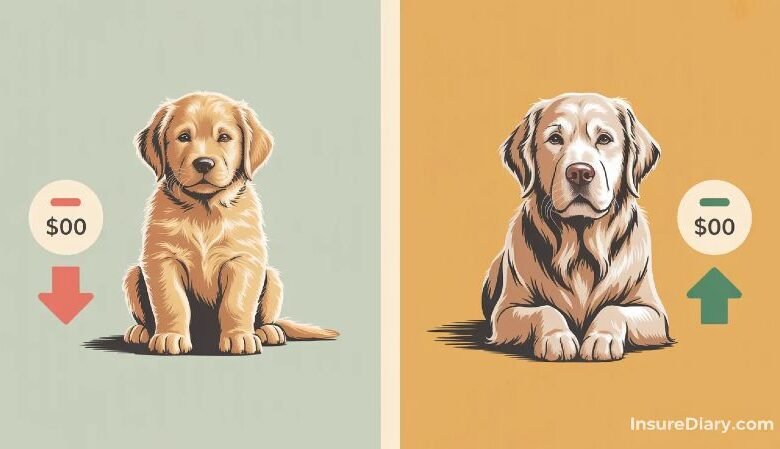
A two-year-old puppy and an eight-year-old dog of the same breed, living in the same ZIP code. The older dog’s insurance premium is nearly double the younger one’s. Same breed. Same neighborhood. Completely different price.
The reason is straightforward: age is one of the most significant pricing factors in pet insurance, and its influence goes beyond just the monthly cost. It affects what conditions are covered, what options are available, and in some cases whether a new policy can be issued at all.
Understanding how age-based pricing works gives you real options. Most of those options disappear once your pet is already sick.
If you are still working through whether pet insurance makes financial sense for your household at all, our overview article on whether pet insurance is worth it is the right starting point before going deeper into age-specific pricing questions.
Why Pet Insurers Weight Age So Heavily
Insurance is built on probability. A two-year-old mixed breed dog has a low statistical likelihood of developing kidney disease or cancer in the next twelve months. A ten-year-old dog of the same breed has a meaningfully higher risk. Insurers price for that difference because they are absorbing it.
This mirrors actuarial logic used across most forms of health and life insurance. Pet insurance in the US is regulated at the state level with no federal oversight, giving insurers considerable pricing flexibility within each state’s rules.
Annual premium recalculation is standard practice at most US pet insurance providers. Rates are reassessed each year at renewal based on your pet’s updated age. Increases tend to be modest in the early years. They become steeper once your pet crosses into what most insurers classify as the senior tier.
According to the North American Pet Health Insurance Association’s 2025 State of the Industry Report, the US pet insurance market wrote more than $4.7 billion in premiums in 2024 — reflecting rising veterinary costs and greater awareness of the financial risk of going uninsured. More product variation across providers makes comparison shopping more valuable now than it was a few years ago.How Premiums Change Across Your Pet’s Life
The premium increase is not a single jump at one birthday. It follows a curve. The slope is gentle in the early years and steepens considerably once a pet enters middle age and beyond.
Here is how US insurers typically segment life stages for pricing purposes. These ranges are approximate and vary by provider and breed size:
| Life Stage | Dogs (Approximate Age) | Cats (Approximate Age) | Premium Trend |
|---|---|---|---|
| Puppy or Kitten | 8 weeks to 1 year | 8 weeks to 1 year | Lowest starting premiums |
| Young Adult | 1 to 3 years | 1 to 4 years | Stable with modest annual increases |
| Adult | 3 to 6 years | 4 to 8 years | Moderate increases at renewal |
| Senior | 7 to 10 years | 9 to 12 years | Steeper increases, fewer plan options |
| Geriatric | 10 years and older | 12 years and older | Highest premiums, some providers limit new enrollment |
Breed size adds another layer. Large and giant breed dogs are often classified as senior earlier than small breeds because their average lifespan is shorter. A Great Dane may enter the senior pricing tier at five or six years old. A small mixed breed might not reach that threshold until eight or nine.
Large dogs also cost more to insure at every life stage. Their medications require higher doses, surgeries involve more anesthesia, and recovery times tend to be longer. Age and size compound each other in the pricing formula.

The Enrollment Cutoff Most Pet Owners Do Not Expect
Many pet owners assume they can buy a policy whenever they are ready. That assumption breaks down for older pets. Most US pet insurance providers set a maximum enrollment age for new applicants. Once your pet passes that threshold, they will not issue a new policy regardless of how healthy the animal appears at the time.
Enrollment cutoffs vary by provider. Some companies are more flexible about senior enrollment than others. A small number of providers do not publish a maximum enrollment age, though premiums at advanced ages will still reflect the higher risk.
The more pressing issue at enrollment is not the cutoff itself. It is the pre-existing condition review that happens when an older pet applies. Every condition documented in your pet’s veterinary records before the policy’s effective date is a candidate for exclusion.
For a young pet that might mean a single ear infection. For a ten-year-old dog it can mean arthritis, dental disease, a history of urinary issues, and early kidney markers are all excluded from day one. The policy exists. It just does not cover the conditions most likely to generate a bill.
This is the core case for enrolling early. Conditions that develop after your enrollment date while you have active coverage are treated as new claims. Conditions that already existed when you applied are excluded. The earlier you enroll, the cleaner that slate is.
What Coverage Actually Looks Like for Older Pets
Getting a policy for a senior or geriatric pet is still possible in many situations. But the coverage landscape changes.
| Coverage Type | What It Covers | Best Fit for Older Pets |
|---|---|---|
| Accident-Only | Injuries from sudden events: broken bones, lacerations, ingested objects | Pets with significant pre-existing conditions where illness coverage would be heavily excluded |
| Comprehensive | Accidents plus illnesses including cancer, organ disease, infections | Senior pets in good health with a relatively clean medical record |
| Comprehensive + Wellness | Everything above plus routine care, bloodwork, dental cleanings, screenings | Senior pets needing frequent preventive care visits each year |
Routine wellness visits increase in frequency for senior pets, making the cost math on wellness add-ons more favorable than it is for younger animals.
For a detailed side-by-side explanation of what accident-only versus comprehensive plans actually cover, see our article on accident-only vs comprehensive pet insurance.
Accident-Only Plans for Older Pets
Accident-only pet insurance covers sudden injuries. It does not cover illness, cancer, or the organ failures that become statistically more likely as pets age. For a geriatric pet with a long list of pre-existing conditions, a comprehensive plan may cost significantly more while covering very little of what is actually likely to happen. In that situation, an accident-only policy can serve as a financial floor against sudden trauma at a much lower monthly cost.
It is not a complete solution. But it is better than no coverage when an unexpected emergency happens.
Hereditary Conditions and Why Timing Matters for Certain Breeds
Some of the most expensive pet health conditions are genetic. They are present in a breed’s biology from birth, but many do not produce clinical symptoms until middle age or later. This creates a coverage timing problem that catches breed-specific owners off guard.
Hip dysplasia commonly surfaces in German Shepherds and Labrador Retrievers between ages four and seven. Certain heart conditions in Cavalier King Charles Spaniels tend to develop in the middle years. Progressive retinal atrophy in breeds like Miniature Schnauzers may not produce visible symptoms until later in life.
How insurers handle these conditions varies considerably. Some providers exclude hereditary conditions for specific breeds categorically regardless of whether any symptoms have been documented. Others only exclude conditions where clinical signs already exist in the veterinary record. A third group covers hereditary conditions if the pet was enrolled before symptoms appeared.
According to the Insurance Information Institute, policy language around hereditary conditions is one of the most variable areas across US pet insurance products. Reading the actual policy definitions before buying is not optional for owners of breeds with known predispositions.Our article on pet insurance and hereditary conditions walks through how different policy types handle these clauses and what questions to ask before enrolling a breed-specific pet.

What This Looks Like in Practice
Hypothetical scenario for illustration purposes only.
Carlos and Maria from Aurora, Colorado had been putting off pet insurance for their Labrador, Duke, for years. He seemed healthy and the monthly cost felt unnecessary. At nine years old, Duke began limping. Their vet documented early hip dysplasia and noted a small abdominal mass during the same visit. Both findings went into his medical record.
Six weeks later the family applied for coverage. Several insurers declined because of Duke’s age. The plans that did accept him excluded musculoskeletal conditions and any growth-related issues based on the recent vet notes. Their chosen plan cost $138 per month with a $750 deductible and 70% reimbursement.
Eight months in, Duke needed surgery for the abdominal mass. The bill came to $4,800. The claim was denied because the mass had been documented before the policy’s effective date. The family paid out of pocket.
Had they enrolled Duke at age two, their monthly premium would have been roughly $42 and the surgery would likely have fallen within covered illness treatment. The lesson is not that pet insurance always works out. It is that timing determines what the policy actually covers.
How Annual Renewals Can Change Your Coverage
Two things commonly shift at renewal time. Premium increases are expected at most US pet insurance providers. Rates are reassessed annually based on your pet’s updated age.
What catches some pet owners off guard is that certain insurers may also add new exclusions at renewal based on conditions that were diagnosed and claimed during the prior policy year. This practice is allowed in many states, though the specifics vary. Some states have stronger policyholder protections that limit or restrict this kind of post-claim modification.
The National Association of Insurance Commissioners recommends that pet owners review renewal documents carefully each year rather than assuming coverage continues unchanged.One more consideration before switching insurers as your pet ages: moving to a new provider means a new waiting period before coverage activates and a new pre-existing condition review. For an older pet, that gap carries more risk than it would for a younger animal.
Practical Strategies for Managing Costs as Your Pet Ages
Compare quotes from at least four providers before ruling out comprehensive coverage. Premium variation for senior pets is wider than at any other life stage. What one insurer prices at $160 per month, another may offer for $95 with comparable terms.
Use your deductible strategically. A higher annual deductible lowers your monthly premium. For a senior pet where you are primarily protecting against major illness or surgery rather than minor claims, a $500 to $1,000 deductible often makes the monthly math more manageable.
Evaluate wellness add-ons based on your pet’s actual care usage. Take last year’s routine vet spending and compare it against the wellness add-on cost. For senior pets that number often justifies the rider.
Ask for a written exclusion list before signing anything. Any insurer offering coverage to an older pet with a medical history should be willing to provide a written list of all conditions that will be excluded from day one.
Ask about multi-pet discounts if applicable. Some providers offer household discounts when multiple pets are insured under the same account.
Should You Insure a Very Old Pet?
The honest answer is: it depends on your pet’s current health history and your own financial position.
A geriatric pet with several documented conditions whose most likely future treatments are already excluded from any available policy may not benefit financially from a comprehensive plan. You would be paying a substantial premium for coverage that excludes the scenarios most likely to occur.
A twelve-year-old cat in genuinely good health with a clean record is a different situation. New conditions can still develop without prior warning. Cancer, acute organ failure, a sudden neurological event — these can cost $8,000 to $15,000 or more depending on the path chosen.
The way to answer this honestly for your specific pet is to run the numbers. Take the annual premium plus the deductible. That is your annual out-of-pocket floor before coverage activates. Compare that against the realistic cost of one major veterinary event for an animal of that age, species, and health status.

Key Takeaways
Enroll your pet early. The younger the pet at first enrollment, the lower your starting premium and the fewer pre-existing condition exclusions you face.
Senior pricing thresholds differ by insurer and by breed size. Do not assume the same rules apply across companies.
Pre-existing condition rules vary by insurer and state. Request a written exclusion list before signing any policy for an older pet.
Accident-only plans exist as a practical middle-ground option for older pets with significant medical histories.
Annual renewals can bring both premium increases and, in some states, new condition exclusions. Review renewal documents before auto-renewing each year.
Comparison shopping matters more for senior pets than any other age group. Price and coverage variation is widest at this tier.
Frequently Asked Questions
There is no single age where this is true for every pet. It depends on your pet’s current health record and what coverage is actually available to them. A healthy eleven-year-old cat may still qualify for a plan covering new illnesses at a reasonable premium. A nine-year-old dog with multiple documented conditions may find that most of the likely future costs are already excluded. Get real quotes based on your pet’s actual records before drawing a conclusion.
Most US pet insurers do not cancel active policies solely because a pet reaches a certain age. Enrollment age cutoffs typically apply to new applicants only. Existing policyholders generally continue at renewal as long as premiums are paid. However, insurers can increase premiums significantly and in some states may add exclusions based on conditions claimed in prior years.
Yes. Large and giant breed dogs are typically classified as senior earlier than small breeds because of differences in average lifespan. Breeds with known hereditary predispositions may also face additional underwriting scrutiny at enrollment regardless of current age.
Switching means starting a new policy with a new waiting period and a new pre-existing condition review. Any condition that exists at the time you switch will be evaluated as pre-existing by the new provider, even if your previous insurer was covering it. This is one of the main reasons switching pet insurance in a pet’s senior years requires careful thought.
Some US insurers distinguish between conditions that are considered curable and those that are not. A curable pre-existing condition such as a resolved ear infection may become eligible for future coverage after a symptom-free waiting period. An incurable condition such as diabetes or chronic kidney disease is typically excluded permanently. This distinction varies by insurer and is not standard across all US providers.
Disclaimer: This article is for educational purposes only and does not constitute professional insurance or financial advice. Premium ranges, coverage terms, and eligibility rules differ by provider and US state. Speak with a licensed insurance professional before making any coverage decisions for your pet.
Last Updated: June 2026