

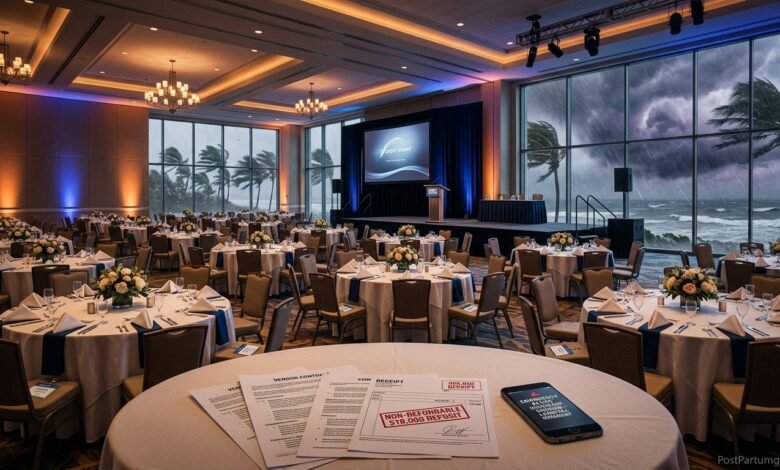
You plan a corporate conference for nine months. A venue takes an $18,000 deposit. You sign catering contracts. A keynote speaker books flights from out of state. Then a Category 2 hurricane makes landfall two days before your event and shuts the entire city down. There is no event. There are no refunds. Unless you are covered.
This is not a hypothetical. Every year events are canceled due to weather, venue failures, illness, and circumstances completely outside an organizer’s control. Event cancellation insurance exists to recover the costs you are stuck with when that happens.
What Is Event Cancellation Insurance?
Event cancellation insurance is a specialty insurance product that reimburses event organizers for proven financial losses when an event cannot proceed or requires significant changes due to causes outside the organizer’s control.
It covers what you have already spent and cannot recover — vendor deposits, prepaid contracts, marketing costs — and in some cases the revenue you expected to collect.
According to the Insurance Information Institute, event cancellation policies are classified as specialty insurance products and are typically underwritten by surplus lines insurers or specialty carriers rather than standard admitted carriers.It is not included in your homeowners policy, your business owner’s policy, or your general liability coverage. It is a standalone product you must purchase separately.
How It Differs from Event Liability Insurance
For context on how liability coverage works in everyday situations, our article on renters insurance covering guest injuries explains personal liability concepts that apply broadly — including at events you host in private spaces.
Event liability insurance covers third-party claims. A guest slips at your event and files a personal injury claim. A vendor’s equipment damages the venue floor. Liability coverage handles those situations.
Event cancellation insurance covers your own financial losses — the money you already spent and cannot get back, and the revenue you were expecting but never received.
Many venues across the US require proof of event liability insurance before they will allow you to book. Very few venues require cancellation insurance. You buy cancellation insurance purely to protect yourself.
Some insurers package both products together. When shopping it is worth asking whether a bundled policy is available since combining them can reduce total premium cost.
What Event Cancellation Insurance Typically Covers

Coverage varies by insurer. There is no single standardized event cancellation policy form in the United States. Reading the actual policy document before committing is non-negotiable.
Non-refundable vendor deposits and prepaid costs. If you paid a caterer $8,000 and the event cancels for a covered reason, the policy reimburses that amount. The same applies to venue deposits, photography contracts, entertainment fees, audiovisual rentals, and any other prepaid service where the vendor keeps your money.
Lost ticket revenue or registration income. For ticketed events, concerts, conferences, or charity fundraisers, the policy can cover revenue you expected but did not receive because the event was canceled. This is typically available as an add-on or built into more comprehensive policies.
Postponement costs. If the event must be rescheduled, costs often increase. A vendor available in April may charge more for a September rebooking. Some policies cover the price difference between the original contract and the rebooking price.
Marketing and promotional expenses. Advertising campaigns, printed materials, and event-specific marketing spend that cannot be recovered may be covered under some policies.
Adverse weather coverage. This specific add-on applies when severe weather makes it unsafe or impossible to hold the event even if the venue itself is undamaged. This coverage is especially relevant for outdoor events in regions prone to hurricanes, tornadoes, blizzards, or extreme heat.
Non-appearance coverage. If a key performer, speaker, or VIP cannot attend due to illness, injury, or a qualifying emergency, some policies cover revenue loss or additional costs that result. This is usually an add-on, not standard coverage.
What Event Cancellation Insurance Does NOT Cover
Poor ticket sales or low attendance. If your event runs but attendance is lower than expected, that is a business risk. Insurance does not cover financial underperformance when the event itself proceeds.
Known risks at the time of purchase. If a named tropical storm is already being tracked when you purchase your policy, losses from that storm will almost certainly be excluded. This is why buying early matters.
Pandemic and communicable disease cancellations. Most event cancellation policies written after 2020 include explicit exclusions for government-mandated shutdowns, pandemic-related closures, and communicable disease restrictions. According to the National Association of Insurance Commissioners, these exclusions became standard in most US market policies following the widespread claim disputes of 2020 and 2021. Some specialty carriers offer pandemic coverage as a separate endorsement but availability is limited and premiums are higher.
Contractual penalties you agreed to. If your vendor contract states you owe a cancellation fee regardless of circumstances, that contractual obligation may not be covered.
Financial failure of the organizer. If the event cancels because the organizing company ran out of money or went bankrupt, that is typically not a covered cause under standard policies.
The Notification Rule Most Organizers Miss
Most event cancellation policies include a notification requirement. You must inform your insurer as soon as you become aware of any event that might trigger a claim — not when you decide to file, not after you have explored all your alternatives.
A common scenario: an organizer discovers her venue is flooded two weeks before the event, spends two weeks finding an alternative venue, then files a claim. The insurer points to a clause requiring notification within 48 hours of discovering any circumstance that may give rise to a claim. Her claim is partially reduced because of the delay.
Read your policy for this clause. Put your broker’s contact information somewhere you can reach immediately if something goes wrong.

How Much Does Event Cancellation Insurance Cost?
As a general benchmark, US insurers typically price event cancellation policies at 1% to 3% of the total insured event budget. That range shifts based on the risk profile of your specific event.
| Event Budget | Event Type | Estimated Premium Range |
|---|---|---|
| Under $10,000 | Private party or small wedding | $100 to $400 |
| $10,000 to $30,000 | Corporate meeting or nonprofit gala | $300 to $900 |
| $30,000 to $75,000 | Mid-size conference or fundraiser | $750 to $2,250 |
| $75,000 to $150,000 | Large conference or regional festival | $1,500 to $4,500 |
| $150,000 to $500,000 | Major festival or multi-day event | $3,500 to $15,000 |
| Over $500,000 | Large-scale ticketed event | Custom quote required |
Estimates only. Vary by location, insurer, and specific risk factors. Always get multiple quotes from licensed carriers.
Who Should Buy Event Cancellation Insurance?

Keeping your underlying insurance in good standing is equally important. Our article on what happens when an insurance policy lapses explains why coverage gaps have consequences even for specialty policies like this one.
Corporate event planners. A 400-person annual conference can accumulate $80,000 to $150,000 in non-refundable costs before a single attendee arrives. Corporate planners managing multiple events per year often purchase annual event insurance programs rather than individual policies, which can reduce per-event costs significantly.
Wedding couples and wedding planners. Weddings are one of the most common use cases. The average American wedding budget in 2025 sits above $30,000. A large portion is committed to non-refundable vendor contracts six to twelve months before the date.
Nonprofit organizations running fundraisers. A charity gala is often one of the largest single revenue events in a nonprofit’s calendar. If that event cancels, the financial impact can disrupt annual operating budgets and grant commitments.
Concert promoters and festival organizers. This is the highest-risk category. A multi-day outdoor festival carries enormous exposure from weather, performer non-appearance, and venue issues simultaneously. Specialty event insurance for festivals is often required by investors, co-promoters, or venue agreements.
Trade show exhibitors and conference sponsors. If you have committed $25,000 to exhibit at an industry conference and that conference cancels, your sunk costs including booth design, shipping, travel bookings, and materials may be recoverable under an exhibitor event policy.
How to Buy Event Cancellation Insurance: Step by Step
- Calculate your total financial exposure. Add up every non-refundable contract, deposit, and prepaid expense. This is your minimum insured value.
- Identify your specific risks. Is the event outdoors? Are you dependent on a single performer? Is the venue in a weather-prone area?
- Contact a specialty event insurance broker. Most standard insurance agents do not write event cancellation policies. The NAIC consumer resources page can help you verify that any broker you work with holds a valid license in your state.
- Request at least three quotes. Policy terms, exclusions, and pricing vary considerably between carriers.
- Read the exclusions section before purchasing. The full exclusions list tells you what you are not buying.
- Purchase as early as possible. Once a specific risk has emerged, coverage for that specific risk becomes unavailable.
- Submit supporting documentation. Provide signed vendor contracts, deposit receipts, and event details.
- Keep copies of everything. A claim without supporting paperwork is a slow claim at best and a denied claim at worst.
State-Level Considerations
Event cancellation insurance is regulated at the state level. Because many policies are written by surplus lines carriers, they may not carry the same state guarantee fund protections that standard policies do. States with large event industries including California, New York, Nevada, Texas, and Florida tend to have more carriers competing for this business.
If you need to verify that a carrier is authorized in your state, the NAIC maintains a directory of all state insurance department contacts.Key Takeaways
For a practical understanding of how insurance discounts and bundling can offset event insurance costs across your broader portfolio, see our article on insurance discounts most people qualify for but never claim.
Event cancellation insurance covers your own financial losses when a covered cause forces cancellation. It does not cover poor attendance, financial failure of the organizer, or risks that existed before the policy was purchased.
Standard liability policies, homeowners policies, and business owner’s policies do not automatically include event cancellation coverage.
Premiums typically range from 1% to 3% of the total insured event budget.
Coverage should be purchased as early as possible — ideally when the first major deposit is paid.
Pandemic, government action, and communicable disease exclusions are now common in US market policies. Verify in writing what is and is not covered before purchasing.
Most policies include a 24 to 48-hour notification requirement. Inform your insurer immediately when any circumstance arises that might give rise to a claim.

Frequently Asked Questions
Yes, as long as no specific known risk has already emerged. If a named storm is already being tracked or your venue has announced problems, coverage related to those specific issues will likely be excluded.
Most policies written since 2021 include explicit exclusions for communicable disease closures and government-mandated shutdowns. Always ask specifically about this exclusion and request written clarification from your broker.
You will generally need signed vendor contracts showing non-refundable amounts, proof of payment, documentation of the covered cause such as a weather report or venue closure notice, and a completed claim form.
Most insurers recommend at least 30 to 60 days before the event. For large events, purchasing when the first major deposit is committed provides the widest coverage window.
Coverage for lost revenue is typically available as an add-on rather than a standard feature. Confirm specifically with your broker whether revenue coverage applies to your event type.
Some policies cover both under the same product. Others require a postponement rider. If rescheduling is a realistic possibility, confirm explicitly whether postponement costs are included before purchasing.
Disclaimer: The information in this article is for educational purposes only and does not constitute professional insurance or financial advice. Coverage terms, exclusions, pricing, and availability vary significantly by insurer and US state. Always consult a licensed specialty insurance broker before making any coverage decisions for your event.
Last Updated: June 2026