

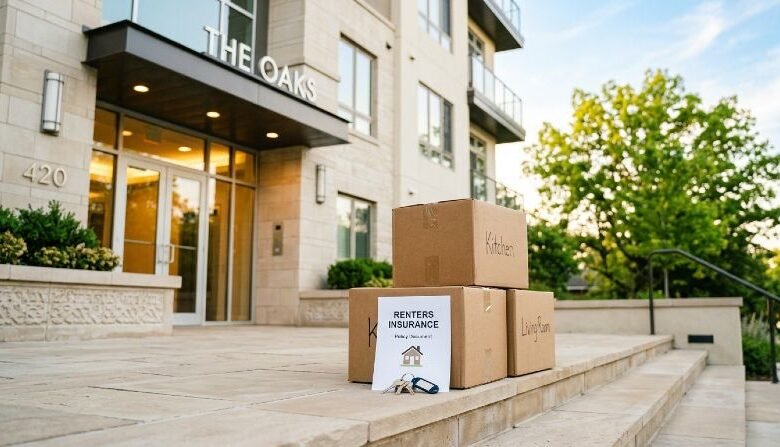
Most people spend weeks planning a move. They compare neighborhoods, book moving trucks, arrange deposits, and coordinate schedules down to the hour. Then they hand back the keys and drive to the new place — without ever calling their insurance company.
For a few weeks, sometimes longer, they are living at a new address with a policy that still shows the old one. Then a pipe bursts on the third night, or someone breaks into the moving truck, and suddenly it matters a great deal.
When it comes to renters insurance and moving, there is one clear rule: a quick call to your insurer before moving day prevents coverage confusion that costs people real money. This guide covers exactly what changes, what stays the same, and what you need to do.
If you are still figuring out how much coverage you need at your new place, our guide on how much renters insurance you actually need is the right starting point before you make any changes to your policy.
Does Your Renters Insurance Follow You When You Move?
Mostly yes — but not automatically in the way most renters assume.
A standard renters insurance policy covers your personal property wherever it physically exists, not just inside your apartment. According to the Insurance Information Institute, personal property coverage under a standard renters policy extends beyond the four walls of your home in most situations.But here is what that coverage does not do on its own:
- It does not update your policy address
- It does not notify your insurer that you have moved
- It does not confirm that your new apartment is a covered location going forward
Your belongings are covered during transit. Your new address is not automatically added to your policy. Those are two entirely different things. The first happens by default. The second requires action from you.
The Coverage Gap That Catches Most Renters Off Guard
There is a window during every move where your situation is genuinely unclear from an insurance standpoint. You still have keys to the old unit. Your furniture is split across two locations. Some nights you are at the new place, some nights elsewhere while the move is still in progress.
Most insurers build in a grace period for newly acquired residences — sometimes 14 days, sometimes 30, depending entirely on your insurer. During that window you are not completely unprotected. But those grace-period terms are not a substitute for a properly updated policy.
The fix is genuinely simple. Call your insurer before your move date. Tell them your new address and when you will be living there. Ask directly how they handle coverage during a transition. That one conversation takes ten minutes and closes a gap that catches thousands of renters off guard every year.

What Actually Changes in Your Policy After a Move
What Stays the Same
Your liability coverage travels with you. If a guest slips in your new kitchen and is injured, your policy’s liability protection applies just as it did at your old apartment.
Your personal property coverage limit also stays the same dollar amount. But this is exactly the right moment to ask whether that amount is still adequate. If you have added furniture, electronics, or appliances since you last reviewed your policy, your current limit may no longer be enough.
What Changes
Your premium may shift. Insurance rates are partly location-based. Moving from a dense urban ZIP code to a quieter suburb might lower your premium. Moving into a flood-prone neighborhood or high-crime area could raise it.
Your declarations page needs to be reissued showing your new address. Your new landlord will likely require this as proof of coverage. The address on that document needs to match your new rental unit, not your old one.
If your landlord is requiring coverage as a lease condition, our article on whether a landlord can legally require renters insurance explains your rights and what landlords can and cannot demand.
| What Changes | What Stays the Same |
|---|---|
| Policy address on file | Personal property coverage limit |
| Monthly premium (recalculated) | Liability coverage |
| Declarations page | Loss of use coverage |
| Grace period terms during transition | Named insured on the policy |
| State regulations if crossing state lines | Deductible amount |
Moving to a Different State Changes More Than Just the Address
A cross-state move is a different situation entirely from a local move.
Renters insurance is regulated at the state level in the US. According to the National Association of Insurance Commissioners, every insurance company must be individually licensed in each state where it sells policies.That matters because your current insurer may not be licensed in your destination state. If they are not, your policy cannot simply transfer over. You will need to find a new provider in your new state.
Start this process at least two to three weeks before your move. That gives you time to compare options, confirm your new policy’s start date, and avoid any period where both your old and new policies have lapsed.

Moving Into a Shared Space or Subletting
Not every move is a straightforward lease-to-lease transition. Many renters move into a shared apartment with a roommate, or sublet for a few months between longer leases. Both situations create insurance questions most people do not think about until something goes wrong.
Roommate Situations
A standard renters insurance policy covers the named insured and sometimes members of your household depending on how the policy is written. It does not automatically extend to a roommate as a separate person.
If you are moving in with a roommate, both of you carrying your own separate policies is the cleanest arrangement. For a full explanation of how coverage works in a shared living situation, see our article on renters insurance for sublet and shared arrangements.
Subletting
If you are subletting your apartment to someone while you are away, your personal property that remains in the unit may or may not be covered while a subtenant is present — this depends on your specific policy language. Always check with your insurer before subletting.
Items in a Storage Unit or Moving Truck
Off-premises coverage under a standard renters policy typically extends to items you own that are temporarily stored somewhere other than your home. But this coverage usually has a sublimit — often 10% of your total personal property coverage. If you have $30,000 in coverage, your storage unit may only be protected up to $3,000.
Moving trucks — your renters insurance may cover belongings inside the truck because they are your personal property. But the moving company’s own liability is typically calculated at a cents-per-pound rate, not replacement value. A $1,200 television weighing 15 pounds might get you $12 from the mover’s liability policy. Your renters insurance replaces it at actual value.
The Steps to Take Before, During, and After Your Move
Before your move: Contact your insurer at least two weeks before your move date. Give them your new address and your intended move-in date. Ask whether they are licensed in your new state if you are crossing state lines. Ask about the off-premises sublimits for items in a moving truck or storage unit.
On moving day: Do not cancel your old policy before your new policy is confirmed active. Keep documentation of any high-value items going into storage — photos and receipts where possible.
After you arrive: Confirm your policy now shows your new address. Request an updated declarations page. Provide that declarations page to your new landlord — the address must match your new unit. Take a video walkthrough of your new apartment showing all your belongings and store it in cloud storage outside your home.

What Your New Landlord Will Ask For
Most landlords who require renters insurance will want a current declarations page showing your active policy and your new address. Some landlords will also ask to be listed as an additional interested party on your policy. This is a standard request and most insurers add it at no cost.
According to research cited by the Consumer Financial Protection Bureau, the national average renters insurance premium sits at roughly $148 per year for standard coverage levels, though rates vary significantly by state and location.Key Takeaways
Your existing policy covers your belongings during a move in most cases, but it does not automatically update your address. You must contact your insurer.
Cross-state moves require extra verification. Your insurer may not be licensed in your new state.
The grace period your insurer provides for a new residence is a temporary buffer, not a long-term solution. Update your policy formally before or immediately after moving in.
Off-premises sublimits apply to storage units and moving trucks. Know your limits before assuming full coverage applies.
Your new landlord needs a declarations page with your new address on it. An old-address document will not satisfy that requirement.
Frequently Asked Questions
In most cases yes. Your personal property coverage extends off-premises to your belongings in transit. But your policy’s off-premises sublimit applies — often 10% of your total personal property coverage. Check your specific policy before assuming full coverage applies.
Not necessarily. If your current insurer is licensed in your new state, they can often transfer or rewrite your policy. If they are not licensed there, you will need to find a new provider. Contact your insurer as soon as you know your destination state.
You should not cancel your existing policy until your new coverage is confirmed active. A gap between cancellation and your new policy start date leaves you unprotected.
Yes. Most landlords who require renters insurance will want a declarations page showing your current active policy and your new address. An old-address document will not satisfy that requirement.
Your renters insurance may still cover your belongings at a temporary location under off-premises coverage. Let your insurer know about the temporary situation so they can clarify what applies.
Yes. Your rate is partly based on your location. Factors like local crime rates, proximity to a fire station, building age, and regional weather risks all influence what you pay.
How Renters Insurance Interacts With Your Security Deposit During a Move
Many renters assume that their security deposit and their renters insurance serve the same purpose. They do not. Understanding the difference prevents both financial surprises and disputes with landlords.
A security deposit protects your landlord against damage you cause to the property and against unpaid rent. Renters insurance does not replace your security deposit obligation. If you accidentally break a window or damage flooring, your landlord can deduct from your deposit regardless of whether you have insurance.
Your renters liability coverage may respond to accidental damage in some situations — specifically when the damage was caused by a covered peril like a fire you accidentally started. But minor wear-and-tear damage, intentional damage, and damage below your deductible threshold all come out of your deposit, not your insurance.
During a move, this distinction matters because both accounts are active simultaneously. The deposit on your old unit is being evaluated at the same time you are setting up coverage for the new one. Keep detailed photographic documentation of both units — at move-out from the old and move-in at the new — to avoid disputes about what damage existed before your tenancy.
The Insurance Implications of Moving in With a Partner or Spouse
Moving in together is one of the most common triggers for renters insurance questions. Whether both people are covered under one policy or need separate policies depends on how the policy is written.
Most US renters insurance policies extend coverage to residents of the household who are related to the named insured or are domestic partners. A live-in partner may be covered under your existing policy if you add them as an additional insured. Some insurers do this automatically when a domestic partner moves in. Others require a formal request and updated policy documentation.
The practical recommendation is to call your insurer before the move and ask two specific questions: does your policy cover a domestic partner who will now be residing in the unit, and what is required to add them formally to the policy?
Two separate policies is sometimes the cleaner arrangement. Each person maintains their own claims history independently. A claim filed by one partner does not affect the other’s record. For couples with different levels of personal property value or different risk profiles, separate policies can also be priced more accurately.
For a full breakdown of what renters insurance covers and how much coverage you actually need, see our guide on how much renters insurance you actually need — especially relevant when combining households.
A Moving Checklist: Insurance Tasks Before, During, and After
This summary condenses the most important insurance actions into a timeline you can follow for any residential move.
30 days before moving: Call your current insurer and notify them of the upcoming move. Confirm they are licensed in your destination state if you are crossing state lines. Ask about grace periods, premium changes, and what documentation your new landlord will need.
2 weeks before moving: Review your current personal property coverage limit. If you have acquired significant new items since your last policy review, update your coverage now. Request a new declarations page listing your new address.
Moving day: Do not cancel your old policy before your new coverage is active. Keep your insurance card and policy number accessible throughout the moving process. Document the condition of both units with photos and video.
First week in new home: Confirm your policy now shows your new address. Provide the updated declarations page to your new landlord. Take a complete video inventory of your belongings in the new space and store it in a cloud account outside your home.
First renewal after moving: Review whether your new location has changed your premium in either direction. Reassess coverage limits based on any new purchases made during or after the move. Confirm your landlord is listed as an interested party if required.

Disclaimer: The information in this article is for educational purposes only and does not constitute financial, legal, or professional insurance advice. Coverage terms, regulations, and pricing vary by insurer, state, and individual policy. Always consult a licensed insurance professional before making any coverage decisions.
Last Updated: June 2026